
Home Interior Cabinets in the Philippines: Designing a Cohesive Home
The most beautifully resolved homes are rarely designed one room at a time. There is a sense of continuity as you move from the kitchen into the living spaces, bedrooms and more private areas of the residence. Materials relate to one another, proportions feel considered, and storage becomes part of the architecture rather than something added afterwards.
This is where home interior cabinets in the Philippines can play a defining role.
While cabinetry is often associated first with the kitchen, thoughtfully designed cabinetry can extend throughout an entire residence—from wardrobes and bathroom vanities to entertainment units, home offices, bars and discreet built-in storage.
At CKC, we approach cabinetry as part of the wider interior: a practical element, certainly, but also one that can establish rhythm, warmth and visual continuity throughout a home.
Thinking Beyond the Kitchen
The kitchen may contain the greatest concentration of cabinetry in a residence, but it does not have to exist in isolation.
A considered cabinetry programme can extend the same design language into adjoining and private spaces. A warm timber introduced in the kitchen, for example, might reappear more quietly in a living-room console or bedroom wardrobe. A particular door profile may be interpreted differently in a vanity or bar.
The objective is not to make every room identical. Rather, it is to create subtle relationships between them.
For homeowners beginning with the kitchen, our guide to luxury kitchen cabinets in Metro Manila explores how layout, materials, appliances and storage can be considered before a renovation begins.
A Whole-Home Approach to Custom Cabinetry
Planning cabinetry across several rooms at the same time offers an opportunity to look at the home as a complete composition.
Depending on the residence, this may include a kitchen and pantry, bedroom wardrobes, a walk-in dressing room, bathroom vanities, entertainment cabinetry, a study, home bar, laundry storage and architectural built-ins.
Each has a different function.
Kitchen cabinetry must respond to food preparation, appliances and everyday workflow. A wardrobe is shaped by clothing and personal routines. A home office needs to accommodate technology, documents and working habits. Living-room cabinetry often has the additional challenge of concealing equipment while remaining visually composed.
This is precisely why custom cabinetry becomes valuable: the interior can be designed around the household rather than the household adapting to predetermined cabinet dimensions.
For a closer look at this philosophy, see our guide to custom cabinets in Metro Manila for a seamless interior.
Creating Continuity Without Making Every Room the Same
A cohesive interior does not require one finish repeated everywhere.
In fact, some of the most sophisticated homes allow each room to develop its own character while maintaining a subtle connection to the rest of the residence.
Continuity might come through related timber tones, complementary neutral finishes, consistent detailing or similar proportions. Hardware can also provide a visual thread, as can the treatment of lighting, shelving and cabinetry panels.
The kitchen might be lighter and more architectural, while the dressing room feels warmer and more intimate. A bathroom vanity can introduce stone or a contrasting finish while retaining details found elsewhere.
The result should feel collected rather than matched.
Custom, Modular or Semi-Modular Cabinets?
Homeowners researching interior cabinets in the Philippines will inevitably encounter several approaches, including ready-made, modular and custom cabinetry.
Ready-made cabinetry offers predetermined sizes and configurations. This can be practical in certain applications, but it provides less freedom when a room has unusual dimensions or when a highly integrated appearance is desired.
Fully custom cabinetry offers extensive freedom in dimensions, finishes, internal arrangements and architectural detailing.
Between these approaches is semi-modular cabinetry, which combines the efficiency and discipline of a cabinet system with the ability to tailor the final design to a particular residence.
CKC works with both semi-modular and personalised cabinetry, allowing the appropriate approach to be considered according to the space, specification and design intent.
Storage Should Begin With How You Live
Beautiful doors are only one part of good cabinetry. What happens behind them is equally important.
Before designing an entire home, it is worth considering what each space actually needs to accommodate.
In a kitchen, that may mean cookware, serving pieces, pantry provisions and small appliances. A dressing room may require a considered combination of long and short hanging, drawers, shelving, shoe storage and dedicated spaces for accessories.
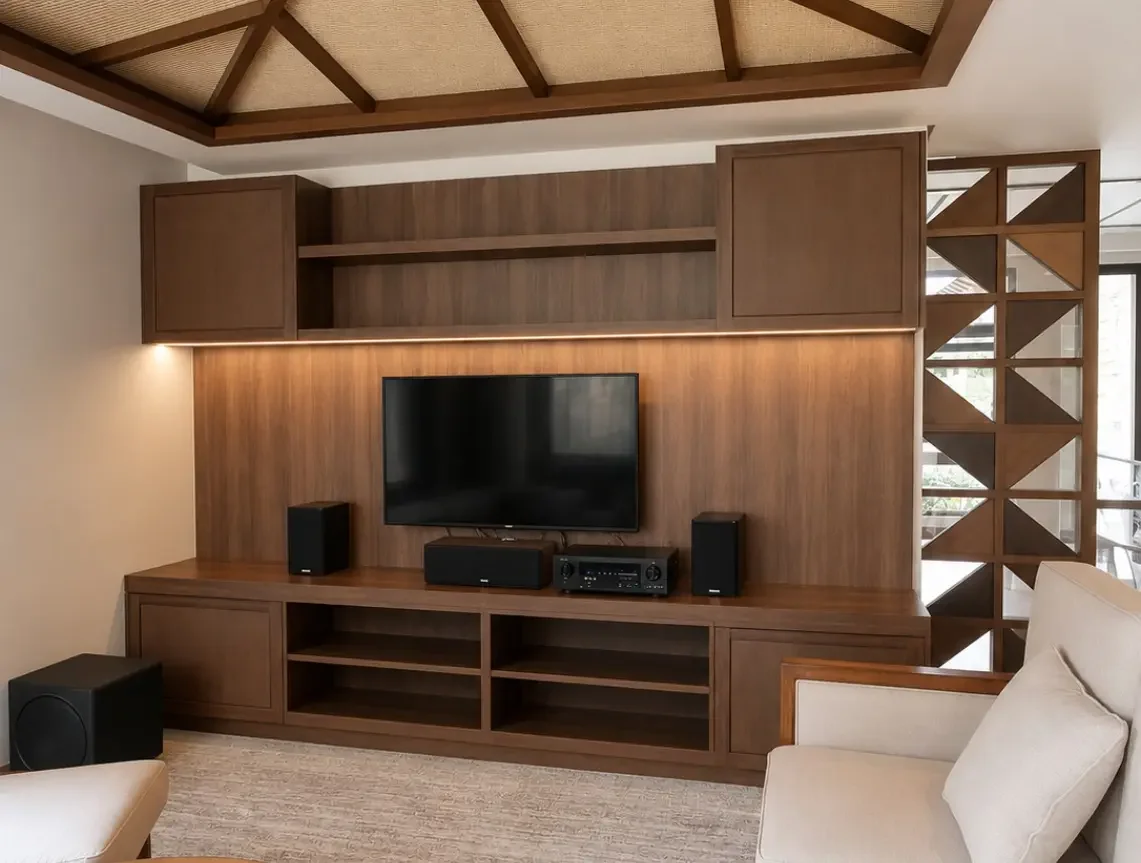
The living room presents different requirements again: television equipment, books, collections, cables and everyday objects may all need a place.
When storage is planned around these realities from the beginning, cabinetry can make the home feel calmer—not because the house necessarily contains fewer things, but because those things have been given an appropriate place.
For homeowners considering a dedicated dressing space, explore our custom walk-in closet ideas.
Materials and Finishes Deserve a Whole-Home Perspective
Selecting cabinetry finishes room by room can eventually result in an interior that feels fragmented.
For larger residences, it can be useful to establish a broader material palette first.
This does not mean limiting the home to one wood or colour. Instead, think of the palette as a family: perhaps a principal timber, several complementary neutrals, selected painted finishes, glass and metal details.
How those materials are distributed can then respond to the atmosphere of each room.
There are practical considerations as well. A frequently used kitchen has different requirements from a bedroom wardrobe, while bathroom cabinetry needs finishes and detailing appropriate to its environment.
The specification should therefore consider both appearance and application.
Cabinetry as Part of the Architecture
Perhaps the greatest distinction between individual cabinets and a considered interior cabinetry scheme is how the cabinetry relates to the architecture itself.
Full-height wardrobes can become part of a bedroom wall. An entertainment unit can frame a living space. A home office can disappear into built-in cabinetry when work is finished. A vanity can establish the visual character of a bathroom.
This approach requires attention to ceiling heights, walls, flooring, lighting, electrical provisions and appliances—not simply the dimensions of a cabinet.
For new homes and substantial renovations, involving the cabinetry team early can make coordination considerably more considered.
Choosing a Cabinet Maker for a Complete Home
A whole-home cabinetry project asks more of a cabinet maker than the ability to fabricate individual units.
Look at the breadth of completed work. Can the same team resolve a kitchen, wardrobe, vanity and living space convincingly? Consider how materials are specified, how internal storage is planned, how cabinetry meets the architecture and how installation is managed.
Price is naturally part of the conversation, but quotations should also be understood in relation to materials, hardware, internal fittings, finishes and project complexity.
Our guide to the cost of premium custom cabinets in Metro Manila explains some of the factors that influence cabinetry investment.
A More Considered Home, Room by Room
The most successful home interior cabinets in the Philippines do more than provide storage.
They bring order to daily life while quietly contributing to the character of the residence. The kitchen works intuitively. Wardrobes accommodate the way their owners dress. Living spaces remain composed. Private rooms feel personal. And throughout the home, there is a visual language connecting one space to another.
A whole-home approach can be seen in our La Vista, Quezon City residence, where cabinetry was developed across the kitchen, bedrooms, walk-in closet, home office, bathrooms, entertainment area, bar and utility spaces. Explore the La Vista, Quezon City custom cabinetry project to see how a consistent cabinetry language can connect distinctly different rooms within one home.
At The Canadian Kitchen Company, we have been creating custom cabinetry in the Philippines since 1996, from kitchens and wardrobes to bathroom vanities, home offices and integrated living spaces. CKC serves residential projects in Metro Manila and across the Philippines.
For homeowners, architects and interior designers planning a new residence or significant renovation, cabinetry is worth considering not simply room by room, but as part of the home as a whole.
Because when cabinetry is thoughtfully planned, it does not merely occupy the interior.
It belongs to it.