
How Much Do Premium Custom Cabinets Cost in Metro Manila?
When planning a new residence or undertaking a significant renovation, cabinetry represents a considerable part of both the interior and the investment. It defines the kitchen, brings order to a private dressing room, completes a bathroom vanity, and can extend throughout the home as discreet architectural storage.
This naturally raises the question: how much do premium custom cabinets cost in Metro Manila?
There is no universal figure—and at this level of cabinetry, there should not be.
Premium custom cabinetry is not priced simply according to the number of doors or metres of storage. The investment reflects the complete specification: materials, finishes, hardware, internal fittings, appliances, fabrication, installation and the complexity of the architecture itself.
Two kitchens of similar dimensions can therefore represent very different investments. Often, what separates them lies in details that are not immediately visible.
What Determines the Cost of Premium Custom Cabinets?
The size of the cabinetry provides an obvious starting point, but square metres or linear metres tell only part of the story.
A streamlined condominium kitchen in Makati may require fewer cabinets than the principal kitchen of a large residence in Ayala Alabang. Yet the smaller kitchen could have an equally considered specification, with integrated appliances, full-extension drawers, concealed hardware and highly detailed finishes.
The scope may also extend beyond the kitchen.
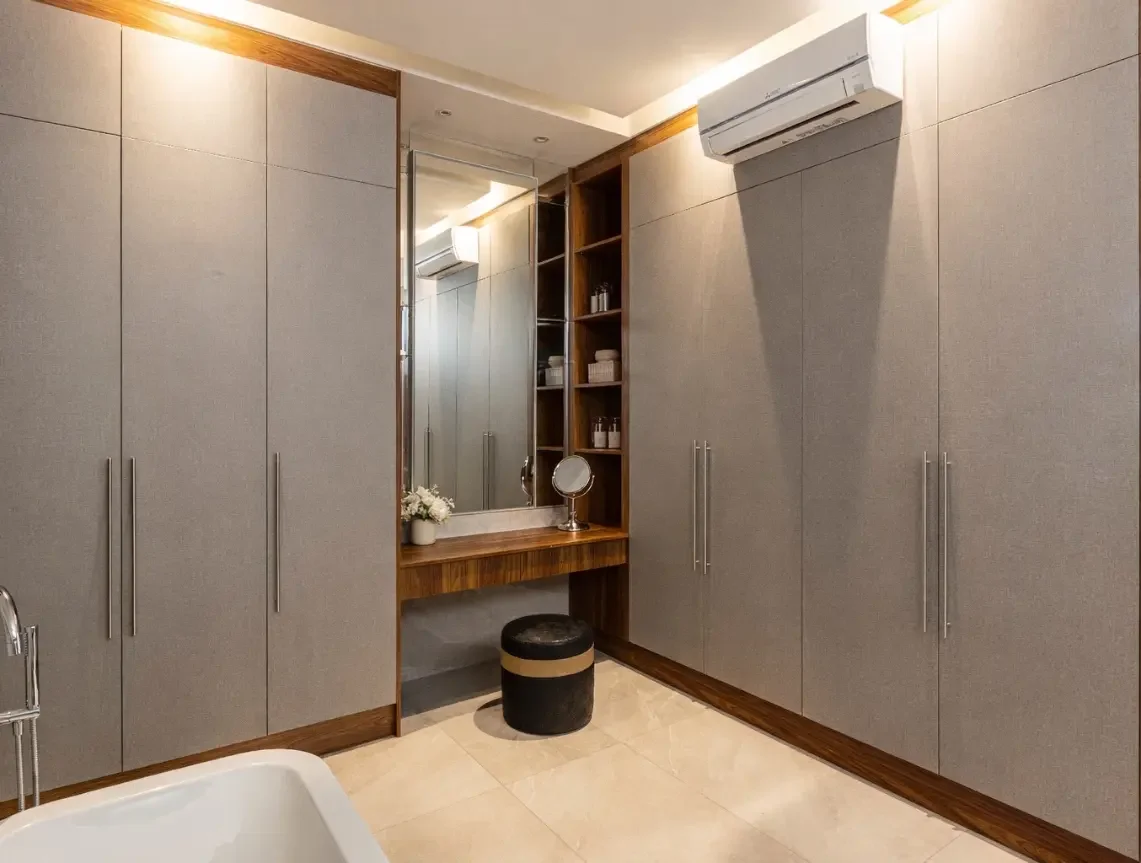
For larger residences, a cabinetry project might encompass a show kitchen, secondary kitchen or pantry, walk-in wardrobes, bathroom vanities, entertainment cabinetry, home offices, bars and other built-in storage.
As the project becomes more individual, the specification becomes a more meaningful measure of cost than size alone.
Materials: What You Don't See Matters
Much of the quality of cabinetry lies beneath its exterior.
The substrate, edge treatment and construction of cabinet boxes and doors all influence how cabinetry performs over time. This is particularly important in the Philippines, where humidity and moisture should be considered when specifying materials.
Different areas of a residence also have different demands. A custom wardrobe in an air-conditioned dressing room is exposed to a different environment from cabinetry beside a kitchen sink or a vanity in a bathroom.
Premium cabinetry therefore involves selecting materials according to their application rather than using a single specification indiscriminately throughout the home.
The visible finish may establish the mood of the room, but the materials beneath it establish its foundation.
Finishes Can Change the Entire Character of the Cabinetry
Finishes are among the most immediately recognisable elements of custom cabinetry.
Warm wood textures can lend depth to an expansive kitchen. Restrained matte surfaces create a quieter architectural expression. Glass-fronted cabinetry can provide moments of display, while contrasting finishes may distinguish an island, bar or particular section of a dressing room.
The complexity of these finishes affects cost.
Custom colours, detailed profiles, combinations of materials and more demanding surface treatments can require additional fabrication and finishing.
Even minimal cabinetry can be surprisingly exacting. When handles disappear, doors sit in uninterrupted planes and visual lines extend across an entire elevation, there is little room for imprecision.
The simpler the composition appears, the more important proportion, alignment and execution become.
Premium Hardware Is an Important Part of the Investment
Cabinet hardware is largely concealed, yet it is one of the elements homeowners experience most frequently.
The distinction can be felt in a heavily loaded drawer that continues to glide smoothly, a wide cabinet door that remains correctly aligned, or a tall pantry that opens and closes with controlled movement.
Premium hinges, full-extension drawer systems, lift mechanisms and specialised fittings add to the cabinetry specification, but they also influence its everyday performance.
For homeowners comparing quotations from cabinet makers in Metro Manila, it is worth looking beyond the words “soft-close.”
Ask which hardware systems are being specified, where they are being used and whether they are appropriate for the size and function of the cabinet.
Hardware is not merely an accessory. In cabinetry intended for years of daily use, it is part of the engineering.
Internal Storage Makes Custom Cabinetry Personal
One of the advantages of custom cabinetry is the ability to design from the inside out.
A kitchen used frequently for entertaining may require generous storage for serving pieces, glassware and table linens alongside everyday cookware. A dedicated pantry can be organised around the household's provisions rather than conventional shelf dimensions.
A private dressing room presents an entirely different brief. Long garments, tailoring, shoes, handbags, watches, jewellery and accessories each benefit from different forms of storage.
These internal configurations can increase the project cost because they involve additional drawers, dividers, mechanisms and specialised components.
Yet this is also where custom cabinetry becomes most meaningful.
Rather than adapting one's possessions to predetermined cabinet dimensions, the cabinetry is composed around the way the household actually lives.
Integrated Appliances Require Precision
In contemporary kitchens, cabinetry and appliances are increasingly considered as one composition.
Built-in refrigerators, ovens, wine storage, dishwashers, coffee machines and concealed range hoods all introduce technical requirements. Dimensions, ventilation, electrical provisions, clearances and door movements must be understood before fabrication.
This becomes especially important when imported or specialist appliances form part of the kitchen.
Early coordination allows cabinetry to frame these appliances precisely while preserving the visual rhythm of the room.
For homeowners undertaking a new build, involving the cabinetry team at the appropriate stage can also help avoid compromises later in the project.
Architecture and Installation Affect Custom Cabinet Cost
No two sites are identical.
Ceiling heights, columns, flooring, walls, plumbing and electrical provisions can influence how cabinetry must be detailed and installed.
A high-rise residence in BGC, Rockwell or Makati may introduce building-specific considerations such as service lift dimensions, delivery schedules and restricted installation hours.
A large private residence may require a different approach altogether, particularly when cabinetry is being installed across several rooms or levels.
This is why site assessment and coordination are integral to custom cabinetry. The objective is not simply to manufacture individual cabinets, but to ensure they meet the architecture with precision.
Why Can Two Cabinet Quotations Be So Different?
A common question arises when homeowners receive quotations that vary considerably despite appearing to cover similar cabinetry.
The drawings may look alike. The specifications may not be.
Differences can include the substrate, finish, edge treatment, hinge and drawer systems, internal accessories, specialised mechanisms, installation scope and after-sales provisions.
One quotation might include fittings that another treats as upgrades. One may specify premium drawer systems throughout, while another reserves them for selected areas.
This is why comparing only the final price can be misleading.
A more useful comparison asks: What exactly am I receiving for this investment?
The quality of the answer often reveals more than the quotation total itself.
Is Price Per Linear Metre a Useful Guide?
Homeowners researching custom cabinet prices in the Philippines will often encounter rates expressed per linear metre.
These figures can provide an initial reference, particularly during early planning. However, their usefulness diminishes as the cabinetry becomes more sophisticated.
A linear metre containing simple shelving is fundamentally different from the same length containing multiple drawers, specialised hardware or integrated appliances. Full-height pantry cabinets cannot be meaningfully compared with low base units solely by length.
Kitchen islands, glass cabinets, concealed doors, wardrobe accessories and bespoke detailing introduce further variables.
For premium residential cabinetry, a detailed project specification is ultimately more informative than a headline rate.
Considering Cabinetry as Part of the Residence
For a home intended to be lived in for many years, cabinetry deserves to be considered beyond its initial price.
It is among the most frequently touched elements of an interior. Drawers are opened countless times. Wardrobe doors become part of the morning routine. Custom kitchen cabinetry must continue to perform through everyday cooking, gatherings and celebrations.
The value of premium custom cabinetry is therefore experienced gradually: in materials selected for their purpose, hardware that continues to operate beautifully, storage that makes sense, and cabinetry that remains visually at ease with the architecture around it.
At CKC, we create premium custom and semi-modular cabinetry for residences in Metro Manila and across the Philippines, including kitchens, walk-in wardrobes, bathroom vanities and integrated storage.
Each project begins by understanding the residence, the requirements of the household and the level of specification appropriate to the space.
Because the most successful custom cabinetry does not simply fill a room.
It becomes part of the architecture of living there.
If you are planning cabinetry for a new residence or a considered renovation, we invite you to schedule a private consultation with CKC. Our team can discuss your space, requirements, preferred materials and the scope of cabinetry envisioned for your home.