
Your Guide to Modular Kitchen Cabinets in the Philippines
A well-designed kitchen should feel effortless.
Cabinet doors align precisely. Appliances sit naturally within the composition. Storage appears where it is needed. Work surfaces remain generous, circulation feels intuitive, and the cabinetry seems to belong to the architecture rather than having been added afterwards.
This is why modular kitchen cabinets have become an increasingly relevant choice for homes in the Philippines.
From compact condominiums in Makati and Bonifacio Global City to larger residences in Forbes Park, Dasmariñas Village, Ayala Alabang, Quezon City, Tagaytay, Cebu, and other parts of the country, homeowners are looking for kitchens that combine efficient planning with a greater degree of personalization.
Yet not all modular kitchens are alike.
Some rely on highly standardized dimensions and finishes. Others take a more flexible, semi-modular approach, allowing cabinetry to respond more closely to the dimensions, architecture, appliances, materials, and lifestyle of an individual home.
Understanding that difference is an important place to begin.
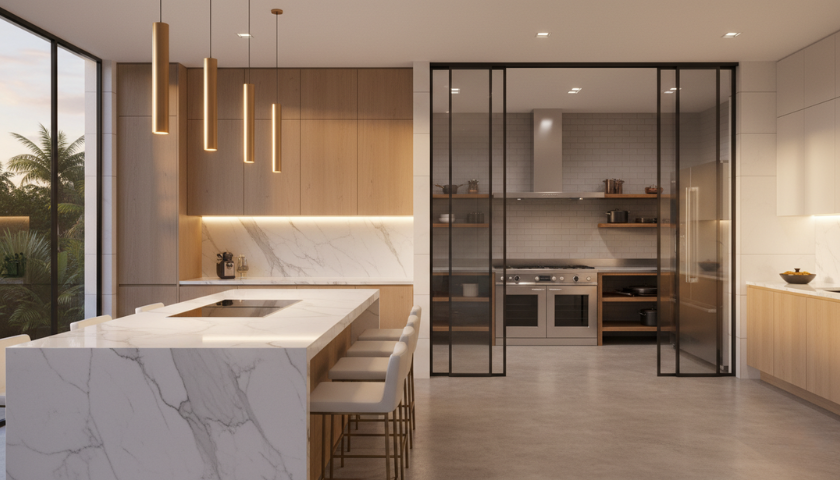
What Are Modular Kitchen Cabinets?
Modular kitchen cabinets are individual cabinet units designed as part of a coordinated system and arranged to create a complete kitchen.
These modules may include:
base cabinets
drawer units
overhead cabinets
tall pantry cabinets
appliance housings
corner cabinets
sink cabinets
island units
specialized storage
Because the cabinetry follows an organized system, dimensions, hardware, proportions, and construction can be planned more consistently.
However, the word modular does not necessarily mean off-the-shelf.
At the premium end of the market, modular principles can be combined with a considerable degree of customization.
That is where semi-modular kitchen cabinetry becomes especially relevant.
What Is the Difference Between Modular and Semi-Modular Kitchen Cabinets?
A useful distinction is this:
TypeGeneral approachBest suited toStandard modular cabinetryPredetermined cabinet sizes and configurationsStraightforward layouts and projects where standardization is suitableSemi-modular cabinetryUses an engineered cabinet system with greater flexibility in dimensions, finishes, configurations, and detailingPremium homes requiring a balance of precision and personalizationFully custom cabinetryDesigned specifically around a particular architectural condition or briefHighly individualized spaces and specialized design requirements
For many Philippine residences, semi-modular cabinetry occupies an attractive middle ground.
It retains the discipline and consistency of an engineered system while allowing the kitchen to respond more naturally to the home.
Rather than forcing the architecture to accommodate a fixed catalogue of cabinet sizes, the cabinetry can be adapted more thoughtfully around the space.
Why Modular Kitchen Cabinets Work Well in Philippine Homes
The appeal of modular cabinetry is not simply convenience.
It is the ability to organize a kitchen systematically while still responding to practical considerations.
Philippine homes present a wide range of conditions.
A condominium in BGC may require compact storage, integrated appliances, and careful use of every available centimeter.
A residence in Ayala Alabang may require an expansive island, pantry, secondary preparation area, or service kitchen.
A Tagaytay home may call for a warmer material palette and a different relationship between indoor and outdoor entertaining.
A family residence elsewhere in the Philippines may have completely different storage habits, appliance requirements, and cooking routines.
Good kitchen cabinetry therefore begins with the home rather than with a catalogue.
1. Start With the Kitchen Layout
Before choosing finishes, door styles, or handles, study the architecture.
Important considerations include:
wall dimensions
windows
doors
ceiling height
structural columns
plumbing locations
electrical points
appliance dimensions
ventilation
circulation
relationship to adjoining rooms
The cabinetry should respond to these conditions rather than compete with them.
This becomes particularly important in open-plan Philippine homes, where the kitchen is often visible from the dining and living areas.
In these spaces, cabinetry becomes part of the architecture of the entire interior.
2. Design Around How the Household Actually Lives
Two kitchens of identical size may require very different cabinetry.
A household that entertains frequently may value a generous island, wine or beverage storage, and beautifully integrated appliances.
A family that cooks extensively may need deep drawers, accessible cookware storage, organized pantry space, and generous preparation surfaces.
A condominium owner may prefer quieter cabinetry that keeps countertop appliances and everyday clutter concealed.
Before designing the kitchen, consider:
Who cooks most often?
How many people use the kitchen at the same time?
Which appliances are used every day?
How much pantry storage is required?
Does the home have a separate service kitchen?
Should the kitchen feel visually open or more discreet?
These questions often matter more than whichever kitchen style happens to be fashionable.
3. Use Storage Intelligently
A successful modular kitchen is not simply one with many cabinets.
The more important question is whether the storage has been allocated intelligently.
Useful solutions can include:
Deep drawers
Ideal for cookware, plates, serving pieces, and frequently used items.
Tall pantry cabinetry
Useful where vertical space can provide considerably more storage than conventional base cabinets.
Pull-out storage
Particularly effective for narrow spaces, pantry goods, oils, bottles, and cooking essentials.
Corner solutions
Thoughtfully planned corner mechanisms can make difficult spaces considerably easier to use.
Integrated waste storage
Waste and recycling can be incorporated discreetly into the cabinetry.
Appliance storage
Smaller appliances may be housed inside dedicated cabinets or appliance zones rather than permanently occupying the countertop.
The objective is not to install every available accessory.
It is to create storage that reflects how the household actually uses the kitchen.
4. Choose Materials Appropriate for the Philippine Climate
Material selection is especially important in the Philippines.
The tropical environment brings humidity, heat, moisture, and changing indoor conditions, all of which should be considered when specifying cabinetry.
Homeowners should look beyond the visible finish and ask about:
cabinet substrates
edge treatment
moisture resistance
construction near sinks
hardware quality
drawer systems
finishes
cleaning requirements
ventilation
installation tolerances
Cabinetry around sinks, dishwashers, cooktops, and other demanding areas may require different considerations from storage located elsewhere in the kitchen.
The most expensive material is not automatically the best choice.
The correct material is the one appropriate to the application, environment, expected use, and design intent.
5. Coordinate Appliances Before Finalizing the Cabinetry
One of the most important steps in kitchen planning is also one of the easiest to overlook.
Appliances should be coordinated before cabinet dimensions are finalized.
Refrigerators, ovens, cooktops, microwave ovens, dishwashers, wine refrigerators, coffee machines, and range hoods all have specific requirements.
These can influence:
cabinet dimensions
ventilation
electrical provisions
plumbing
countertop depth
appliance towers
clearances
drawer locations
overall symmetry
In a refined kitchen, appliances should feel considered as part of the architecture rather than fitted into whatever space remains.
6. Think Beyond the Traditional Kitchen Triangle
The classic relationship between the refrigerator, sink, and cooktop remains useful, but contemporary kitchens often require more.
Larger Philippine homes may contain several working zones:
preparation
cooking
cleaning
pantry
beverage service
breakfast
entertaining
secondary cooking
A well-planned modular or semi-modular kitchen can organize these activities so the room works naturally even when several people are using it.
For larger residences, this may be more useful than designing around a single theoretical triangle.
7. Consider the Kitchen Island Carefully
A kitchen island can become one of the most important elements in a modern home.
But bigger is not always better.
An island should leave enough space around it for comfortable movement and appliance access while still performing a clear function.
Depending on the home, it may provide:
preparation space
seating
storage
a sink
a cooktop
serving space
entertaining space
concealed electrical outlets
additional drawers
In some kitchens, the island becomes the social heart of the room.
In others, a peninsula or uninterrupted workspace may be the more intelligent solution.
Modular Kitchen Cabinets for Condominiums in Metro Manila
Condominium kitchens require particular discipline.
In locations such as BGC, Makati, Ortigas, Rockwell, and other Metro Manila residential districts, the kitchen is often compact and highly visible from the living space.
The cabinetry therefore needs to perform two roles:
maximize function and maintain visual calm.
Useful approaches may include:
full-height cabinetry
integrated appliances
concealed countertop storage
wide drawers
minimal visual breaks
restrained handles
thoughtful lighting
carefully selected materials
When space is limited, good detailing becomes even more noticeable.
A compact kitchen can still feel luxurious when every element appears resolved.
Modular Kitchen Cabinets for Large Philippine Residences
Larger homes bring a different challenge.
More square meters do not necessarily result in a better kitchen.
Without careful planning, large kitchens can become inefficient, with excessive distances between work zones and storage distributed without a clear logic.
In residences in communities such as Forbes Park, Dasmariñas Village, Ayala Alabang, Greenhills, and other established residential enclaves, cabinetry may need to accommodate:
substantial islands
pantry storage
secondary kitchens
wine or beverage areas
appliance walls
breakfast zones
formal entertaining
family dining
service circulation
The objective is not simply to fill a large space with cabinetry.
It is to give the room architectural order.
What Kitchen Cabinet Style Should You Choose?
Style should emerge from the architecture and interior design rather than being selected in isolation.
Some of the most enduring approaches include:
Contemporary
Clean proportions, restrained detailing, integrated hardware, and carefully controlled material combinations.
Warm Minimalism
Simple cabinetry softened by natural-looking wood grains, stone, warm neutrals, and subtle lighting.
Transitional
A balance of traditional proportions with cleaner contemporary detailing.
Modern Classic
Paneled doors, considered mouldings, elegant hardware, and restrained finishes interpreted in a more contemporary way.
Architectural Minimalism
Cabinetry designed to disappear visually, often using handleless doors, integrated appliances, and large uninterrupted surfaces.
For premium homes, the most successful kitchen is rarely the one that follows a trend most literally.
It is the one that feels appropriate to the residence.
Are Modular Kitchen Cabinets Suitable for Luxury Homes?
Yes.
The word modular describes a system of construction and organization. It does not determine the level of quality.
A premium modular or semi-modular kitchen can incorporate:
sophisticated materials
high-quality hardware
integrated lighting
premium drawer systems
custom dimensions
carefully selected finishes
specialized storage
integrated appliances
architectural detailing
What separates an ordinary modular kitchen from a more refined one is often not a single feature.
It is the accumulation of decisions.
Alignment.
Proportion.
Material selection.
Hardware.
Installation.
Lighting.
And the degree to which the cabinetry responds to the architecture.
How Much Do Modular Kitchen Cabinets Cost in the Philippines?
There is no meaningful single price for modular kitchen cabinetry because projects vary significantly.
Cost can be influenced by:
kitchen size
cabinet quantity
materials
finishes
hardware
internal accessories
countertop selection
appliance integration
complexity of installation
customization
location of the project
A small condominium kitchen and a large residential kitchen with an island, pantry, appliance wall, and premium hardware should not be expected to fall within the same budget.
For homeowners considering a premium kitchen, it is often more useful to evaluate specification and long-term value than to compare cabinets solely by price per linear meter.
How Long Do Modular Kitchen Cabinets Last?
There is no responsible universal answer.
The lifespan of kitchen cabinetry depends on several factors, including:
construction
material specification
hardware
installation quality
maintenance
humidity exposure
water exposure
frequency of use
Instead of asking only how many years cabinetry should last, ask:
How has this kitchen been designed to age well?
The answer can often be seen in the details: hinges, drawer mechanisms, edge treatment, moisture-prone areas, alignment, and how easily components can be serviced in the future.
What Should You Ask a Kitchen Cabinet Maker?
Before choosing a cabinet maker in the Philippines, ask questions that go beyond price.
Consider asking:
How is the site measured?
Are the cabinets standard modular, semi-modular, or fully custom?
What materials are used for cabinet interiors and doors?
What hardware is specified?
How are appliances coordinated?
Can cabinet dimensions be adjusted?
Who manufactures the cabinetry?
Who installs it?
How are site irregularities handled?
What happens if adjustments are required after installation?
What after-sales support is available?
Does the company have experience with projects similar to your home?
A beautiful rendering is useful.
But cabinetry ultimately depends on the successful coordination of design, manufacturing, and installation.
CKC's Approach to Semi-Modular Cabinetry
The Canadian Kitchen Company has been creating cabinetry for Philippine homes since 1996.
Over the years, the company's work has evolved from modular cabinetry toward a more flexible semi-modular and highly personalized approach, allowing kitchens and other built-in cabinetry to respond more closely to individual residences.
For CKC, the objective is not simply to supply cabinets.
It is to create cabinetry that feels considered within the architecture of the home—whether for a condominium in Metro Manila, a family residence in the South, or a project elsewhere in the Philippines.
The value of semi-modular design lies in that balance:
the precision of a system, with the flexibility required by a real home.
A Kitchen Designed Around Your Home
Every residence asks for a different response. The right cabinetry should feel considered, precise, and entirely at ease within the architecture.
For homeowners planning a kitchen renovation, new build, or whole-home cabinetry project, CKC offers a semi-modular approach shaped around the way you live. Schedule a private consultation with CKC.