
Stop the Warp: The Ultimate Guide to Climate-Proof Kitchen Materials & Costs in the Philippines
When you scroll through Pinterest or Instagram, every kitchen looks perfect. But there is a harsh reality that most modular kitchen catalogs in the Philippines won't tell you: The tropical climate is a cabinet killer.
We have seen it dozens of times. A homeowner invests a significant amount in a stunning, imported European kitchen. It looks breathtaking for the first year. But by year three, the humidity has done its damage. Doors start to sag, laminates begin to peel, and the sink cabinet swells from moisture.
At Canadian Kitchen Company, we believe true luxury is longevity. Whether you are a local homeowner building your legacy home or an expat settling in Manila, understanding the science of kitchen cabinet materials is the only way to protect your investment.
Here is your comprehensive guide to navigating costs, materials, and durability in the Philippine climate.
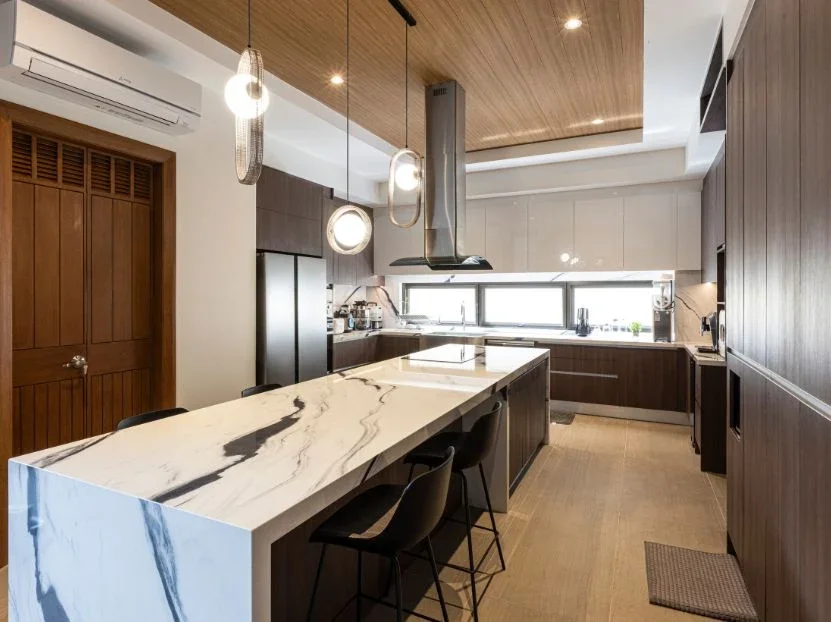
The "Hidden" Cost of Kitchen Renovation in the Philippines
One of the most common searches we see is for "modular kitchen price Philippines." It’s a valid question, but it often leads to the wrong answer.
In the construction industry, we distinguish between Upfront Cost and Lifetime Cost.
The "Cheap" Route: A low-cost modular package might save you 30% today. But if you have to replace warped doors or rusted hinges in 4 years, your actual cost has doubled.
The Investment Route: A high-quality, climate-engineered kitchen might cost more initially, but it lasts 15–20 years.
A Philippine property site explains that kitchen and bathroom remodels often deliver some of the highest returns on condo resale and rental value, with ROI often in the 60–80% range depending on materials and finishes — signaling that the kitchen as a whole (not just small repairs) adds value.
The Great Debate: Marine Plywood vs. HMR vs. Particle Board
This is the technical heart of your kitchen. The "Carcass" (the body of the cabinet) is hidden behind the pretty doors, but it determines if your kitchen survives.
1. Standard Particle Board (Avoid)
This is what you find in most "budget-friendly" or purely imported flat-pack kitchens. It is made of wood chips glued together.
The Risk: In high humidity (common in Metro Manila), this material acts like a sponge. It absorbs moisture from the air, causing it to swell and crumble.
2. HMR (High Moisture Resistance) Board
This is the industry standard for quality mid-range to high-end kitchens. It is engineered with special resins that repel moisture.
The Verdict: Excellent for general storage areas, pantry units, and overhead cabinets.
3. Marine Plywood (The Gold Standard)
For areas near water—specifically the sink and preparation counters—Marine Plywood is the superior choice. It is constructed to withstand significant moisture exposure without losing structural integrity.
The Canadian Kitchen Company Standard:
We don't use generic wood. We utilize a strategic combination of high-density HMR and Marine-grade materials specifically tested for the local climate. We invite you to visit our showroom and perform the "Knock Test." You will hear the difference in density immediately compared to lighter, hollow alternatives.
Aesthetics That Last: Finishes and Countertops
Once the core is solid, we look at the skin. In a country where cooking often involves high heat, oil, and heavy usage, your finish needs to be more than just pretty.
Matte Anti-Fingerprint: Perfect for modern, sleek homes, but requires high-quality manufacturing to ensure oils don't stain.
High-Gloss Acrylic: Reflects light and makes smaller condos feel larger.
Textured Laminates: Adds warmth and hides scratches better than paint.
15 Beautiful Kitchens From Real Homes — showcases multiple distinct kitchen looks (e.g., earthy wood kitchens, Scandinavian-inspired palettes, industrial touches, and modern variants) pulled directly from real Philippine homes.However, be warned: Not all laminates are created equal. We use industrial-grade pressing techniques to ensure the laminate never peels away from the wood core—a common failure point in cheaper modular cabinets
The Engine of the Kitchen: Heavy-Duty Hardware
You open your cutlery drawer 20 times a day. You open your pantry door 10 times a day. That is over 10,000 movements a year.
Many competitors cut costs by using "standard" runners. At CKC, we believe the hardware is the engine. We exclusively use world-class, heavy-duty hinges and runners that are rated for significant weight.
Soft Close: Standard on all our units.
Weight Bearing: Our drawers can hold your heavy cast-iron pots without bowing or getting stuck.
The "Local Manufacturing" Advantage
This is our unique position in the market. We carry the name Canadian Kitchen Company because we adhere to Western manufacturing standards of precision and quality. However, we are proudly established locally.
Why does this matter for you?
No "Filler" Panels: Imported kitchens come in standard box sizes (e.g., 60cm, 90cm). If your wall is 95cm, they use a 5cm "filler" strip of wood. It wastes space. Because we build locally, we customize the cabinet to exactly 95cm, giving you maximum storage.
Spare Parts Availability: If a child hangs on a door and breaks a hinge, you don't have to wait 4 months for a part to ship from Europe. We support our clients instantly.
Climate Acclimatization: Our materials are stored and processed in the local climate, preventing the "shock" that happens when wood moves from a dry European winter to a humid tropical summer.
Build It Once, Build It Right
Your kitchen is the heart of your home. It sees the most traffic, the most heat, and the most memories. Don't compromise on the materials that hold it all together.
If you are researching kitchen renovation costs or comparing materials, don't just look at the price tag. Look at the density, the hardware, and the warranty.
Ready to feel the difference?
Visit the Canadian Kitchen Company showroom today. Let our designers show you what "Climate-Ready Luxury" feels like. Book a Design Consultation Here